Bear Market Economic Solutions

Bear Market Economics, News and Issues

FAIR USE NOTICE

FAIR USE NOTICE

A BEAR MARKET ECONOMICS BLOG

Occupy Economics and the Economy


This site may contain copyrighted material the use of which has not always been specifically authorized by the copyright owner. We are making such material available in an effort to advance understanding of environmental, political, human rights, economic, democracy, scientific, and social justice issues, etc. we believe this constitutes a ‘fair use’ of any such copyrighted material as provided for in section 107 of the US Copyright Law.

In accordance with Title 17 U.S.C. Section 107, the material on this site is distributed without profit to those who have expressed a prior interest in receiving the included information for research and educational purposes. For more information go to: http://www.law.cornell.edu/uscode/17/107.shtml

If you wish to use copyrighted material from this site for purposes of your own that go beyond ‘fair use’, you must obtain permission from the copyright owner.

FAIR USE NOTICE FAIR USE NOTICE: This page may contain copyrighted material the use of which has not been specifically authorized by the copyright owner. This website distributes this material without profit to those who have expressed a prior interest in receiving the included information for scientific, research and educational purposes. We believe this constitutes a fair use of any such copyrighted material as provided for in 17 U.S.C § 107.

Read more at: http://www.etupdates.com/fair-use-notice/#.UpzWQRL3l5M | ET. Updates
FAIR USE NOTICE FAIR USE NOTICE: This page may contain copyrighted material the use of which has not been specifically authorized by the copyright owner. This website distributes this material without profit to those who have expressed a prior interest in receiving the included information for scientific, research and educational purposes. We believe this constitutes a fair use of any such copyrighted material as provided for in 17 U.S.C § 107.

Read more at: http://www.etupdates.com/fair-use-notice/#.UpzWQRL3l5M | ET. Updates

All Blogs licensed under Creative Commons Attribution 3.0

Creative Commons License
This work is licensed under a Creative Commons Attribution 3.0 Unported License.


Friday, February 19, 2016

Heads up! Thomas Piketty supports Bernie Sanders, "without hesitation!"


Dk-logo-med


Heads up! Thomas Piketty supports Bernie Sanders, "without hesitation!" (FB quote)?!? POW!

 
By geebeebee  
Friday Feb 05, 2016 · 1:50 PM EST


BernieJane.jpg


OK, this is a heads-up, as it’s not 100% confirmed yet, but it appears Thomas Piketty, of Capital in the Twenty-First Century and The Economics of Inequality fame, has essentially endorsed Bernie!

Here’s the fb link:  www.facebook.com/…

It came from a Senior Lecturer from the University of York, so I’m hoping it’s solid!
You heard it here first: 
 "Of course I support Bernie Sanders, without hesitation!" -- Thomas Piketty, just now.
So nothing confirmed yet, but let’s hope for this, as it would be awesomeness!

VOTE BERNIE SANDERS.


Posted by NOTES FROM THE WILDSIDE at 12:48 AM No comments:

Thomas Piketty Feels The Bern


Thomas Piketty Feels The Bern

The economist says Sanders is the only candidate who's willing to tax the rich.

02/16/2016 06:33 pm ET | Updated 2 days ago


MATTHIEU ALEXANDRE via Getty Images
French economist Thomas Piketty's op-ed about Bernie Sanders wasn't an outright endorsement, but signaled clear support for the Vermont senator.


Bernie Sanders is the great hope for America's economic future, according to French economist Thomas Piketty.

In his latest weekly column, Piketty wrote that the Vermont senator's campaign represents a turning point in the country. "[W]e are witnessing the end of the politico-ideological cycle opened by the victory of Ronald Reagan at the 1980 elections," he wrote in a piece that appeared in French in Le Monde earlier this week and in English in the Guardian on Tuesday.

The French rockstar economist is the author of Capital in the Twenty-First Century, which showed that global income inequality has gotten much, much worse in the 36 years since Ronald Reagan was first elected. Piketty's life's work is about showing how low tax rates on the rich, particularly in the United States, exacerbate inequality for those of us below the top 1 percent, or even 0.1 percent, of earners.

In that sense, Piketty has a bone to pick with the U.S. government, and anyone who represents its economic policy over the last three decades. It is through this lens that Piketty looks at the current presidential race and sees Sanders as the hope for "a new political cycle":
Sanders makes clear he wants to restore progressive taxation and a higher minimum wage ($15 an hour). To this he adds free healthcare and higher education in a country where inequality in access to education has reached unprecedented heights, highlighting a gulf standing between the lives of most Americans, and the soothing meritocratic speeches pronounced by the winners of the system.
Piketty dislikes the Republicans as a group: The "party sinks into a hyper-nationalist, anti-immigrant and anti-Islam discourse ... and a limitless glorification of the fortune amassed by rich white people," he wrote.
But he has almost as much disdain for Clinton based on her connections to the establishment, since even under Democratic presidents (Bill) Clinton and Barack Obama, Reagan's low tax rates continued.

"Hillary Clinton, who fought to the left of Barack Obama in 2008 on topics such as health insurance, appears today as if she is defending the status quo, just another heiress of the Reagan-Clinton-Obama political regime," Piketty writes.
The Clinton of 2016, for the record, may be more moderate than Sanders, but is running substantially to the left of her 2008 campaign.


Posted by NOTES FROM THE WILDSIDE at 12:28 AM No comments:

Thomas Piketty says Bernie Sanders can “change the face of the country”

SALON


Tuesday, Feb 16, 2016 04:50 PM EST

Thomas Piketty says Bernie Sanders can “change the face of the country”

"Sanders’s success today shows that much of America is tired of rising inequality"

Sophia Tesfaye

Thomas Piketty says Bernie Sanders can "change the face of the country”

Thomas Piketty (Credit: AP/Janerik Henriksson)


In a new op-ed published in the Guardian on Tuesday, famed French economist and author of Capital in the Twenty-First Century, Thomas Piketty credits Democratic presidential candidate Bernie Sanders with waking the larger American political establishment up to the problem of rising income inequality and channelling the Democratic electorate’s righteous outrage. Piketty says that Sanders’ campaign proves that a leader like Sanders—if not Sanders himself—“could one day soon win the U.S. presidential elections and change the face of the country.”

“Because he is facing the Clinton machine, as well as the conservatism of mainstream media, Sanders might not win the race,” Piketty observes, but, “in many respects, we are witnessing the end of the politico-ideological cycle opened by the victory of Ronald Reagan at the 1980 elections.”

Both former president Bill Clinton and President Barack Obama have failed to even attempt real tax reform, allowing for inequality to run rampant, according to Piketty. “Sanders’ success today” however, Piketty argues, “shows that much of America is tired of rising inequality and these so-called political changes, and intends to revive both a progressive agenda and the American tradition of egalitarianism”:
Sanders makes clear he wants to restore progressive taxation and a higher minimum wage ($15 an hour). To this he adds free healthcare and higher education in a country where inequality in access to education has reached unprecedented heights, highlighting a gulf standing between the lives of most Americans, and the soothing meritocratic speeches pronounced by the winners of the system.
“Meanwhile,” Piketty notes, “the Republican party sinks into a hyper-nationalist, anti-immigrant and anti-Islam discourse (even though Islam isn’t a great religious force in the country), and a limitless glorification of the fortune amassed by rich white people.” And Sanders’ rival, Hillary Clinton, is now “just another heiress of the Reagan-Clinton-Obama political regime.”

Despite observing that “the judges appointed under Reagan and Bush have lifted any legal limitation on the influence of private money in politics,” Picketty is not resigned to doom, instead crediting the Sanders campaign with offering a real counter to fight unlimited campaign contributions rather than succumbing to its power.

“New forms of political mobilization and crowdfunding can prevail and push America into a new political cycle,” Picketty wrote. “We are far from gloomy prophecies about the end of history.”


Sophia Tesfaye Sophia Tesfaye is Salon's Deputy Politics Editor. You can find her on Twitter at @SophiaTesfaye.
Posted by NOTES FROM THE WILDSIDE at 12:18 AM No comments:

Thomas Piketty on the rise of Bernie Sanders: the US enters a new political era


The Guardian


Thomas Piketty on the rise of Bernie Sanders: the US enters a new political era


The Vermont senator’s success so far demonstrates the end of the politico-ideological cycle opened by the victory of Ronald Reagan at the 1980 elections


Bernie Sanders makes clear he wants to restore progressive taxation and a higher minimum wage.

Bernie Sanders makes clear he wants to restore progressive taxation and a higher minimum wage. Photograph: Evan Vucci/AP


How can we interpret the incredible success of the “socialist” candidate Bernie Sanders in the US primaries? The Vermont senator is now ahead of Hillary Clinton among Democratic-leaning voters below the age of 50, and it’s only thanks to the older generation that Clinton has managed to stay ahead in the polls.

Because he is facing the Clinton machine, as well as the conservatism of mainstream media, Sanders might not win the race. But it has now been demonstrated that another Sanders – possibly younger and less white – could one day soon win the US presidential elections and change the face of the country. In many respects, we are witnessing the end of the politico-ideological cycle opened by the victory of Ronald Reagan at the 1980 elections.

Let’s glance back for an instant. From the 1930s until the 1970s, the US were at the forefront of an ambitious set of policies aiming to reduce social inequalities. Partly to avoid any resemblance with Old Europe, seen then as extremely unequal and contrary to the American democratic spirit, in the inter-war years the country invented a highly progressive income and estate tax and set up levels of fiscal progressiveness never used on our side of the Atlantic. From 1930 to 1980 – for half a century – the rate for the highest US income (over $1m per year) was on average 82%, with peaks of 91% from the 1940s to 1960s (from Roosevelt to Kennedy), and still as high as 70% during Reagan’s election in 1980.

This policy in no way affected the strong growth of the post-war American economy, doubtless because there is not much point in paying super-managers $10m when $1m will do. The estate tax, which was equally progressive with rates applicable to the largest fortunes in the range of 70% to 80% for decades (the rate has almost never exceeded 30% to 40% in Germany or France), greatly reduced the concentration of American capital, without the destruction and wars which Europe had to face.

A mythical capitalism

In the 1930s, long before European countries followed through, the US also set up a federal minimum wage. In the late 1960s it was worth $10 an hour (in 2016 dollars), by far the highest of its time.

All this was carried through almost without unemployment, since both the level of productivity and the education system allowed it. This is also the time when the US finally put an end to the undemocratic legal racial discrimination still in place in the south, and launched new social policies.

All this change sparked a muscular opposition, particularly among the financial elites and the reactionary fringe of the white electorate. Humiliated in Vietnam, 1970s America was further concerned that the losers of the second world war (Germany and Japan in the lead) were catching up at top speed. The US also suffered from the oil crisis, inflation and under-indexation of tax schedules. Surfing the waves of all these frustrations, Reagan was elected in 1980 on a program aiming to restore a mythical capitalism said to have existed in the past.

The culmination of this new program was the tax reform of 1986, which ended half a century of a progressive tax system and lowered the rate applicable to the highest incomes to 28%.

Democrats never truly challenged this choice in the Clinton (1992-2000) and Obama (2008-2016) years, which stabilized the taxation rate at around 40% (two times lower than the average level for the period 1930 to 1980). This triggered an explosion of inequality coupled with incredibly high salaries for those who could get them, as well as a stagnation of revenues for most of America – all of which was accompanied by low growth (at a level still somewhat higher than Europe, mind you, as the old world was mired in other problems).

A progressive agenda

Reagan also decided to freeze the federal minimum wage level, which from 1980 was slowly but surely eroded by inflation (little more than $7 an hour in 2016, against nearly $11 in 1969). Again, this new political-ideological regime was barely mitigated by the Clinton and Obama years.

Sanders’ success today shows that much of America is tired of rising inequality and these so-called political changes, and intends to revive both a progressive agenda and the American tradition of egalitarianism. Hillary Clinton, who fought to the left of Barack Obama in 2008 on topics such as health insurance, appears today as if she is defending the status quo, just another heiress of the Reagan-Clinton-Obama political regime.

Sanders makes clear he wants to restore progressive taxation and a higher minimum wage ($15 an hour). To this he adds free healthcare and higher education in a country where inequality in access to education has reached unprecedented heights, highlighting a gulf standing between the lives of most Americans, and the soothing meritocratic speeches pronounced by the winners of the system.

Meanwhile, the Republican party sinks into a hyper-nationalist, anti-immigrant and anti-Islam discourse (even though Islam isn’t a great religious force in the country), and a limitless glorification of the fortune amassed by rich white people. The judges appointed under Reagan and Bush have lifted any legal limitation on the influence of private money in politics, which greatly complicates the task of candidates like Sanders.

However, new forms of political mobilization and crowdfunding can prevail and push America into a new political cycle. We are far from gloomy prophecies about the end of history.

This piece was first published in Le Monde on 14 Febrary 2016
Posted by NOTES FROM THE WILDSIDE at 12:04 AM No comments:

Wednesday, February 17, 2016

World's Most Famous Economist Says Bernie Sanders Could "Change the Face of the Country"


Policy.Mic


World's Most Famous Economist Says Bernie Sanders Could


World's Most Famous Economist Says Bernie Sanders Could "Change the Face of the Country"

Zeeshan Aleem's avatar image By Zeeshan Aleem February 16, 2016

Thomas Piketty, perhaps the most influential economic thinker of the left in the Western world, is impressed by the rise of Sen. Bernie Sanders.
In a post for Le Monde republished on Tuesday by the Guardian, the French economist outlined why he felt the populist senator's ascent spells "the end of the politico-ideological cycle opened by the victory of Ronald Reagan at the 1980 elections." Piketty argues that regardless of Sanders' fate in this particular contest, he has created an opening for similar candidates in the future —"possibly younger and less white" — who could successfully make it into the White House and "change the face of the country."
What's most interesting about Piketty's analysis is that he doesn't see Sanders as following in the footsteps of Europe's social democratic models, but rather leading the United States toward a possible return to the nation's pioneering 20th century experiments with extremely progressive taxation and social spending.
World's Most Famous Economist Says Bernie Sanders Could "Change the Face of the Country"
Source: Eric Piermont/Getty Images
America's golden past: Piketty points to the fact that, prior to Reagan, 20th century fiscal policy in the U.S. was aggressive in taxing the wealthy — much more so than the European counterparts that American leftists are so fond of looking to for inspiration today.
"In the interwar years the country invented a highly progressive income and estate tax and set up levels of fiscal progressiveness never used on our side of the Atlantic," Piketty wrote. "From 1930 to 1980 — for half a century – the rate for the highest U.S. income (over $1 million per year) was on average 82%, with peaks of 91% from the 1940s to 1960s (from Roosevelt to Kennedy), and still as high as 70% during Reagan's election in 1980."
Those rates — which refer to marginal income tax rates, not the rate at which every dollar someone earns is taxed — played a tremendous role in creating social equality and helped provide crucial government revenue for robust social programs that were introduced during Franklin Roosevelt's New Deal and Lyndon Johnson's Great Society. 
The U.S. also instituted estate taxes (federal taxes on property transferred from someone who has died to their heirs) that were also extremely high and dwarfed rates in France and Germany. 
That all changed after Reagan won the White House. In a bid to "restore a mythical capitalism to have existed in the past," as Piketty put it, he took an axe to the tax code and lowered the rate for the highest incomes to 28%. 
World's Most Famous Economist Says Bernie Sanders Could "Change the Face of the Country"
Source: Getty Images/Getty Images
Third way politics: Since Reagan, the Democratic Party has largely operated within the paradigm carved out by Reagan: very high tax rates are un-American; keeping the deficit low is of paramount importance; and spending on social services are worthwhile but should not be overly generous. In the 1990s Bill Clinton, who once famously declared that "the era of big government is over," spearheaded the Democrats' attempt to adjust to this overarching fiscal vision and only gently challenged Reagan's tax parameters. And Barack Obama has not sought to alter that status quo. The top tax rate now is just under 40% — a far cry from the top income tax rate of over 90% that existed during the time of Dwight Eisenhower.   
For Piketty, Clinton is "another heiress of the Reagan-Clinton-Obama political regime," while Sanders represents a meaningful break from it.
"Sanders' success today shows that much of America is tired of rising inequality and these so-called political changes, and intends to revive both a progressive agenda and the American tradition of egalitarianism," Piketty wrote. 
Sanders has his work cut out for him this primary season, but even if he loses the race for the nomination, it seems his popularity already represents a victory for his ideas — and a mighty blow to advocates for the political status quo.
Posted by NOTES FROM THE WILDSIDE at 9:00 AM No comments:

Saturday, February 6, 2016

Follow the Revolution


Home


Is Sanders making a "political revolution"?

Todd Chretien looks at the strengths of Sanders' case against Corporate America and his views on socialism--and considers what his decision to run as a Democrat means.

September 3, 2015
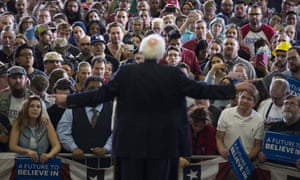
Bernie Sanders on the campaign trailBernie Sanders on the campaign trail
BERNIE SANDERS' bid to unseat Hillary Clinton as the Democratic Party's heir apparent to the White House has shaken up election season and given a voice to millions of people who have had it with a political system wholly owned by the 1 Percent.
It is very important for the left that Sanders has injected the question of socialism into the mainstream political discussion. His run also raises questions that the left needs to discuss and confront, including the main contradiction of his campaign: The independent senator from Vermont is running for the presidential nomination of the Democratic Party, which is also owned by the 1 Percent--and he has repeatedly promised to support whoever the party's nominee is, even Clinton, rather than an independent left-wing campaign for president.
Sanders' popularity has been one of the main political stories of the summer. More than 100,000 people have crammed into rallies from Portland, Maine, to Los Angeles to cheer him on. "The reason we're doing so well in this campaign," Sanders told the crowd in LA, "is we're telling the truth."
That truth is the radical message of the 99 Percent, revived from the heyday of Occupy Wall Street. "Today," reads Sanders' campaign website, "we live in the richest country in the history of the world, but that reality means little because much of that wealth is controlled by a tiny handful of individuals."
Sanders is making an issue out of raising the wages of the lowest-paid workers, disproportionately women, the young, and people of color. "The current federal minimum wage is starvation pay and must become a living wage. We must increase it to $15 an hour over the next several years," his campaign states. That effort, Sanders says, also has to include targeting the sexist wage gap. "We must also establish equal pay for women. It's unconscionable that women earn less than men for performing the same work."
Early in his campaign, Sanders stumbled badly in not forthrightly denouncing police brutality, but he has gotten more in step with the Black Lives Matter movement over the summer. His campaign website's "Racial Justice" section reads, in part: "Sandra Bland, Michael Brown, Rekia Boyd, Eric Garner, Walter Scott, Freddie Gray, Tamir Rice, Samuel DuBose. We know their names. Each of them died unarmed at the hands of police officers or in police custody. The chants are growing louder. People are angry and they have a right to be angry."
Although not perfect, he supports eight out of 10 of the demands made by Campaign Zero to oppose police brutality, more than any other candidate among the Democrats and Republicans.
Sanders is pushing other urgent issues, such as climate change and campaign finance, into the spotlight. And to top it off, he proudly declares himself a socialist, pointing to the great revolutionary and leader of the early 20th century Socialist Party Eugene Debs as his hero.
- - - - - - - - - - - - - - - -
THE ENTHUSIASM for Sanders--which his supporters refer to as "the Bern"--should come as no surprise, given the steady decline in living conditions for the vast majority of people in the U.S.
American capitalism has been turning up the heat on the working class for decades. The power of the labor movement has been broken, destroying millions of lives in the process--a mere 11.2 percent of U.S. workers now belong to a union, including just 6.6 percent of private-sector workers.
Student debt is out of control, sticking nearly 40 million students with a trillion dollars in debt and decades of loan payments. Obamacare filled in a few potholes, but remained committed to the corporate health care system that protects insurance company and Big Pharma profits.
Obama has replaced--for the moment--U.S. boots on the ground with death from drones in the sky, while backing reactionaries around the Middle East, from fully funding the Saudi Arabian invasion of Yemen, to supporting the Egyptian generals' counterrevolution and Israel's never-ending war on the Palestinian population.
Despite years of growing activism, police brutality against poor people of all races is getting worse--the disproportionate targeting of young Black men, women and transgender people is escalating. And any time large numbers of people take it to the streets to protest, occupy or strike, they are met with a united front of militarized police and a New Jim Crow judicial system.
Sanders' popularity is the result of his giving voice to the discontent with this 21st-century version of what Malcolm X called the "American nightmare." His campaign isn't the only sign of protest: There is the Black Lives Matter movement, System Change Not Climate Change mobilizations planned for this fall and the Fight for 15 struggles of low-wage workers, to name a few.
Internationally, mass protests and anti-austerity or anti-capitalist electoral campaigns have come together in mutually reinforcing, if complex and contradictory, ways; including SYRIZA (and now Popular Unity) in Greece, Podemos in Spain, the Left and Workers Front in Argentina, Jeremy Corbyn's left-wing campaign to lead the Labour Party in Britain, and an array of fights in Ireland, Scotland and South Africa.
All this raises big questions about how to understand Sanders' campaign, his decision to run within the decidedly pro-capitalist and pro-austerity Democratic Party--and what can be done to transform Sanders' slogan of a "political revolution" into a sustained movement that doesn't live and die with Sanders as an individual.
- - - - - - - - - - - - - - - -
ONE OF the worst things about American elections is the notion that politics is really about supporting this or that politician as an individual--which usually means pretending they are above reproach. The reality is that, despite Sanders' many strong progressive positions, there are several issues on which his supporters should hold him accountable.
In 2014, Sanders supported the unanimous U.S. Senate resolution backing Israel's brutal bombing and invasion of Gaza, which killed more than 2,000 Palestinians. After the September 11 attacks in 2001, Sanders voted in favor of George Bush's Authorization of Use of Force resolution that was used to launch the disastrous invasion of Afghanistan. Back in 1994, Sanders voted in favor of Bill Clinton's 1994 crime bill, one of the central pillars of the system of police brutality, racially biased sentencing laws and mass incarceration.
So Sanders has participated in digging some of very holes that he now says he can help us climb out of.
And these far-from-radical stances aren't all in past either. For example, Sanders stunned progressives last weekend with his statement, in an interview with ABC News' George Stephanopoulos, that he wouldn't end the U.S. military's drone war in the Middle East and elsewhere. "What you can argue is that there are times and places where drone attacks have been effective," he said.
- - - - - - - - - - - - - - - -
SANDERS' DECISION to take these positions wasn't accidental, nor are they examples of him simply "selling out" or "pandering." Rather, they flow from his strongly held political beliefs and his particular vision of socialism.
In 2006, Sanders described to Democracy Now! what socialism meant to him:
I think it means the government has got to play a very important role in making sure that, as a right of citizenship, all of our people have health care; that as a right, all of our kids, regardless of income, have quality child care, are able to go to college without going deeply into debt; that it means we do not allow large corporations and moneyed interests to destroy our environment; that we create a government in which it is not dominated by big money interest. I mean, to me, it means democracy, frankly. That's all it means.
To achieve these goals, Sanders looks to the Scandinavian version of what is usually called "social democracy"--building a strong welfare state through gradual reform and developing a mixed economy where the state and public ownership plays a larger role, but big business remains powerful.
Historically, this reformist vision of socialism has more in common with the most conservative elements in the Socialist Party, such as congressman Victor Berger, than it has with Eugene Debs' politics.
In the U.S. context, any attempt to come to some sort of accommodation with the structures of American capitalism and its state means hoping to find common ground with a system that is not only built on the ruthless exploitation of all working-class people, but also relies on institutional racism at home and permanent war abroad.
This political point of view, and not any personal corruption, is what has led Sanders in the past to take the positions described above. He would do better to look to the preamble to the constitution of the Industrial Workers of the World, which Debs himself helped to found in 1905:
The working class and the employing class have nothing in common. There can be no peace so long as hunger and want are found among millions of the working people and the few, who make up the employing class, have all the good things of life. Between these two classes, a struggle must go on until the workers of the world organize as a class, take possession of the means of production, abolish the wage system and live in harmony with the Earth.
- - - - - - - - - - - - - - - -
BY THEMSELVES, these positions wouldn't necessarily stop a group like the International Socialist Organization (ISO) from supporting Sanders if we believed the overall thrust of his campaign was to create an ongoing political alternative to the two-party status quo. In that case, we might well join the Sanders campaign, while publicly putting forward our disagreements.
The ISO disagreed with Ralph Nader on certain questions, but we supported his independent presidential campaigns in 2000 and 2004 because they were part of building up the global justice and antiwar movements and helping them start to break free from the control exerted by the Democratic Party.
But the biggest difference is that Sanders is running in the Democratic Party. As Ashley Smith wrote for Socialist Worker:
Sanders' decision to jump into Democratic Party presidential politics represents a decisive break from the man he calls his hero: Eugene V. Debs. Debs spent his whole life building the Socialist Party as an alternative to the two capitalist parties. Year in and year out, he insisted that "[t]he differences between the Republican and Democratic Parties involve no issue, no principle in which the working class have any interest."
Debs understood that his call for working-class people to break with the two capitalist parties meant supporting a political alternative that might not win--but he believed this was a necessary challenge to a two-party system that offered nothing to workers. "I'd rather vote for something I want and not get it," Debs once wrote, "than vote for something I don't want and get it."
We've seen the left involve itself with the Democrats time and again: From the Communist Party's decision to support Franklin Roosevelt in 1936 (the CP has been trapped inside the Democrats for the last 80 years!) to Students for a Democratic Society's "Half the Way with LJB" endorsement of Lyndon Johnson in 1964 (Johnson sent 500,000 troops to Vietnam shortly after winning the election); to Jesse Jackson's Rainbow Coalition primary campaigns in 1984 and 1988 (which pulled almost all of the 1960s and 1970s radical left into the Democrats).
That brings us back to Sanders, who has supported the Democratic presidential candidate for many elections now, and not any of the left-wing independent campaigns, like Nader's in 2000 and 2004. Rather than pulling the Democrats to the left, entering the party requires an accommodation to the big money and elite politicians who really own and control it.
Sanders has repeatedly promised that no matter what, he will support "the eventual Democratic nominee"--and the New York Times reported in early September that he will soon sign a joint fundraising agreement with Hillary Clinton to raise money for that "eventual" nominee.
In all likelihood, Sanders will be asking all the millions who back him now precisely because he is not Hillary Clinton to get behind her as the lesser evil sometime next spring or summer.
- - - - - - - - - - - - - - - -
SO WHAT would Eugene Debs do about the campaign of a man who says he reveres him as a hero?
Debs would no doubt extend a hand in friendship to the millions of ordinary working-class people who are looking to Sanders. The vast majority of Sanders enthusiasts are sick of complacency and seeking out ways to join in the fight to change the world. To paraphrase Debs, "They want to vote for something they want."
But if Sanders will end up asking them to vote for something they don't want, what are our options?
Some genuinely radical socialists, such as those in and around Jacobin magazine, and organizations like Socialist Alternative and Solidarity, argue that radicals need to find ways to join in the Sanders campaign.
The ISO disagrees with this because, after all, the goal of the Sanders campaign is to win as many votes as possible inside the Democratic Party, a party revolutionaries cannot support. Instead, we believe we should be up-front with his supporters and engage in a discussion about why Sanders, who is asking so many of the right questions, has pledged allegiance to a party that has all the wrong answers.
And far from waiting around passively, we should use the current political atmosphere to build an alternative. There is a significant layer of workers and students, especially activists, who have learned the painful lessons of how the Democratic Party uses and abuses the left. These people can find ways now--for instance, Jill Stein is running to be the Green Party presidential candidate, and on the local level, socialist Kshama Sawant is up for re-election to the Seattle City Council this November--to begin posing a clear alternative in the 2016 elections.
From Greece to Scotland to Argentina, social movements and political campaigns have proven that the old parties of austerity can be challenged by new, more radical ones. Breaking out of the old straightjackets can open up the potential for deeper changes than will ever be permitted within the limits of the U.S. two-party system.
Posted by NOTES FROM THE WILDSIDE at 7:39 PM No comments:

Friday, February 5, 2016

Why Capitalism Can't be Sustainable


green economist


Why Capitalism Can't be Sustainable


'For fear, perhaps, of arriving at a different conclusion, there is an unspoken (and largely untested) assumption that there need be no fundamental contradiction between sustainable development and capitalism. That assumption stands in stark contrast to the prevailing view of many radical academics and non-governmental organizations (NGOs) that there are profound (and possibly unmanageable) contradictions which demand a completely different world order.'

So writes Jonathon Porritt in his book Capitalism as if the World Matters. He concludes not that we should seek to replace capitalism with a better, fairer and more ecologically friendly economic system, but that we must work with capitalism since it is the only show in town. I would beg to differ: see my presentationWhy capitalism is not sustainable (ppt, 6607 K).

Capitalism Closing Down Sale
Capitalism is an economic system where production is controlled by the people who organize exchange, or trade, rather than the producers. This is wasteful, since value is extracted by people who are not productive. A green economy cannot be a wasteful economy since we must reduce our consumption of the earth's resources and so have to ensure that those we use are used efficiently.

Capitalists seek to accumulate capital to increase their power in the market. This is also wasteful. The system also requires constant growth and the search for new markets leads to wasteful production and exhausting and unsatisfying consumption (my paper relating the relative definition of poverty (pdf, 141 K) to economic growth can be downloaded here). A green economy would rather be a provisioning economy where we met our emotional needs through community rather than consumption and where we would produce high-quality goods which would be valued and mended, rather than merely creating demand through stimulus mechanisms like built-in obsolescence.
Posted by NOTES FROM THE WILDSIDE at 2:47 PM No comments:
Newer Posts Older Posts Home
Subscribe to: Posts (Atom)

Featured Post

The Need to Rid the World of Inequality

The Need to Rid the World of Inequality Review of The 1% and the Rest of Us by Kim Petersen / August 10th, 2016 Legalized chattel ...

Revolution vs War

Revolution vs War
  • LIBERAL LINKS

BEAR MARKET ECONOMICS BLOGS

  • Bear Market Economics Blogs
  • Bear Market Economics Home

Popular Posts

  • LIBERAL LINKS
    The Most Comprehensive Guide to U.S. Politics ... since 1997 LIBERAL LINKS (CENTER-LEFT, ...
  • Occupy Wall Street: FAQ for those still confused
    Occupy Wall Street: FAQ Nathan Schneider September 30, 2011 Q: I hear that Adbusters organized Occupy Wall Street? Or Anony...
  • Why Not Socialism?
    Why Socialism? January 23, 2014     By David Glenn Cox     Washington D.C. — Underscoring his Administration’s commitm...
  • How the Trailer Park Could Save Us All
    PACIFIC STANDARD How the Trailer Park Could Save Us All A healthy, inexpensive, environmentally friendly solution for housing millio...
  • If Every Rich Person Were Like This Multimillionaire, The World Would Be A Better Place
    If You Only News If Every Rich Person Were Like This Multimillionaire, The World Would Be A Better Place By ...
  • Put Your Money Where Your Mouth Is: Ten Ways to Democratize Our Broken Economy
      Take Action Ten Ways to Democratize Our Broken Economy September 26, 2013     by Gar Alperovitz and Keane Bhat...
  • Millionaire Grocery Clerks: The Amazing WinCo Foods Story
    Forbes Entrepreneurs Millionaire Grocery Clerks: The Amazing WinCo Foods Story Mary Josephs   ,     CONTRIBUTOR I write ...
  • Bringing Socialism Back: How Bernie Sanders is Reviving an American Tradition
    IN THESE TIMES With Liberty and Justice for All Bringing Socialism Back: How Bernie Sanders is Reviving an American Tradition Th...
  • Thanks for Asking, Fix the Debt! We Do Know How to Fix Social Security
                 Thanks for Asking, Fix the Debt! We Do Know How to Fix Social S ecurity  Richard (RJ) Eskow ...
  • The Need to Rid the World of Inequality
    The Need to Rid the World of Inequality Review of The 1% and the Rest of Us by Kim Petersen / August 10th, 2016 Legalized chattel ...

Blog Archive

  • ▼  2016 (23)
    • ▼  September (4)
      • The 1 Percent's Problem
      • Millionaire Grocery Clerks: The Amazing WinCo Food...
      • EnMo Economics: An Article in Two Parts
      • The Need to Rid the World of Inequality
    • ►  August (2)
    • ►  March (1)
    • ►  February (8)
    • ►  January (8)
  • ►  2015 (20)
    • ►  December (2)
    • ►  November (3)
    • ►  October (1)
    • ►  September (2)
    • ►  August (2)
    • ►  July (2)
    • ►  June (1)
    • ►  May (4)
    • ►  April (1)
    • ►  March (1)
    • ►  February (1)
  • ►  2014 (37)
    • ►  November (2)
    • ►  July (1)
    • ►  June (1)
    • ►  May (4)
    • ►  April (10)
    • ►  March (5)
    • ►  February (7)
    • ►  January (7)
  • ►  2013 (41)
    • ►  November (5)
    • ►  October (2)
    • ►  September (4)
    • ►  August (4)
    • ►  July (3)
    • ►  June (7)
    • ►  May (4)
    • ►  April (8)
    • ►  March (3)
    • ►  January (1)
  • ►  2012 (29)
    • ►  December (1)
    • ►  November (1)
    • ►  October (2)
    • ►  September (2)
    • ►  August (3)
    • ►  July (6)
    • ►  June (5)
    • ►  May (1)
    • ►  April (1)
    • ►  January (7)
  • ►  2011 (58)
    • ►  December (7)
    • ►  November (8)
    • ►  October (12)
    • ►  September (4)
    • ►  August (6)
    • ►  July (12)
    • ►  June (1)
    • ►  May (5)
    • ►  April (3)
  • ►  2010 (2)
    • ►  February (2)
Simple theme. Theme images by Nic_Taylor. Powered by Blogger.